Beckett's Political Imagination by Morin Emilie
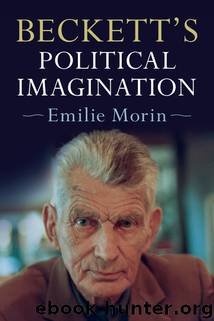
Author:Morin, Emilie
Language: eng
Format: epub, mobi
Publisher: Cambridge University Press
Published: 2017-07-28T04:00:00+00:00
States of Transition
Beckett's letters suggest that he looked upon French politics after 1944 with a mixture of amusement, fascination and irritation. He followed attentively the trials of the former heads of the Vichy government: his correspondence comments on Philippe Pétain's performance at his hearing in 1945 as ‘the poor old misled man and hero of Verdun’, refers to the attempted assassination of Pierre Laval, once the effective head of the Vichy government, prior to his trial and execution, and mentions the attempt of Marcel Déat, a former normalien, prominent collaborationist minister and representative of the Vichy militia, to flee the country.19 An exchange with Arland Ussher suggests that Beckett perceived little difference between 1944 and 1946, and that the collaborationists and the military still served the same function. Ussher had sent him an essay that situated French collaborationism in a broader historical continuum reaching back to the eighteenth century and described the two world wars as the outcome of the nineteenth-century ‘religion of nationalism’.20 Beckett's account of the political situation in December 1946 is very clear: ‘Flourishing, particularly the military representatives, they are happily engaged in reorganising the salvation of the country. They are prepared to forget and forgive – the so rude interruption’.21
Other letters commenting on French literary life are indignant: in August 1945, for example, Beckett notes that ‘[t]he same crowd, writing & painting, tops the bill that has topped it since the liberation’.22 De Beauvoir's memoir features the negative image of Beckett's remark: ‘The men now in power had been in the Resistance and, to a greater or lesser extent, we knew them all. […] Politics had become a family matter, and we expected to have a hand in it’.23 In his letters to Duthuit, Beckett greeted these developments with contempt. Their dialogue has an external referent: Duthuit's short-lived review, Transition, which published occasional commentaries in English on the post-war purges and more specific matters including Louis-Ferdinand Céline's situation.24 In 1952, for example, Beckett comments upon an issue of Combat in which Breton evoked his certainty that the war would eventually end, even in the darkest hours of Nazi occupation. Beckett's response, ‘Veinard, va’ (lucky devil), is clearly a jibe at Breton's decision to move across the Atlantic at that precise moment.25 The same letter dismisses ungainly metaphors in an essay that nevertheless advances views similar to his own: Julien Gracq's ‘La littérature à l'estomac’, which portrays a ‘republic of letters’ in which the sharp political divergences of 1945 have not been mended and anti-intellectualism is on the rise.26 A translation of the essay – one of many to which Beckett contributed – was published in Transition.27 Beckett's diagnoses are certainly apt: Gisèle Sapiro has shown that the post-war purges did not foster radical transformations in Parisian literary production, but a generational passing of powers and the formation of literary alliances that merely exacerbated dynamics created long before the war, around nationalisation and the conquest of autonomy.28 The war's aftermath was also the terrain of a ‘counterpurge’
Download
Beckett's Political Imagination by Morin Emilie.mobi
This site does not store any files on its server. We only index and link to content provided by other sites. Please contact the content providers to delete copyright contents if any and email us, we'll remove relevant links or contents immediately.
Still Me by Jojo Moyes(11277)
On the Yard (New York Review Books Classics) by Braly Malcolm(5528)
A Year in the Merde by Stephen Clarke(5441)
Eleanor Oliphant Is Completely Fine by Gail Honeyman(5287)
The Bookshop by Penelope Fitzgerald(3857)
How Music Works by David Byrne(3273)
Surprise Me by Kinsella Sophie(3116)
Pharaoh by Wilbur Smith(2994)
Why I Write by George Orwell(2958)
A Column of Fire by Ken Follett(2616)
Churchill by Paul Johnson(2590)
The Beach by Alex Garland(2565)
The Songlines by Bruce Chatwin(2563)
Aubrey–Maturin 02 - [1803-04] - Post Captain by Patrick O'Brian(2308)
Heartless by Mary Balogh(2263)
Elizabeth by Philippa Jones(2208)
Hitler by Ian Kershaw(2203)
Life of Elizabeth I by Alison Weir(2091)
Harry Potter and the Cursed Child by J. K. Rowling & John Tiffany & Jack Thorne(2068)
